Third Waylon-ism
Truth, Compromise, and the Biblical Tensions that We Must Hold


Waylon is my seven year old Boykin Spaniel. He is a welcomed resident in my house of three daughters. He steals food, drinks out of the toilet, and thinks I can do no wrong. He’s a man’s dog. Though thoroughly domesticated, his primal instincts often belie his docile appearance. Not long ago he stole a ribeye bone out of the trash can. I caught him in the act. I considered letting him chew it up but visions of four-digit vet bills made me think otherwise. A second approach occurred to me. I could wrestle it out of his jaws. While I do not know the exact compressive force of a dog’s mouth, it rivals any junk yard car crusher. This would not be easy. A third option came to my mind, higher and better than the other two. We still had part of a ribeye left over from our dinner. I dangled a slice in front of his face causing an existential crisis for my canine friend. His eyes glistened at the delectable treat wagging in front his nose and his mouth trickled drool down the bone onto a puddle on the floor. He had three options: which one would he take?
I cannot remember the first time I heard the phrase “Third-way ism.” In evangelicalism, it refers to a philosophy of holding to biblical tensions, forgoing the natural tendency to collapse into simplistic binaries. John Stott never used the term “Third Way-ism”, but he often employed such an approach. He was fond of pitting two extremes against one another while proffering a preferred middle ground. For example, in The Contemporary Christian, Stott writes that believers should use “double listening” – listening simultaneously to both God’s Word and the modern world (he made sure to qualify: the latter should be evaluated in deference to the former). This fits within Stott’s larger missiological framework rejecting both isolationism (a fundamentalist withdraw) as well as accommodationism (a liberal surrender). He writes, “We are neither to withdraw from the world nor to become indistinguishable from it, but to serve it with the mind of Christ.” This is Stott’s Third Way-ism in action – engagement without capitulation, faithfulness without fear.
I find the following chart to be helpful as it captures several instances of Stott’s “Third Way”:
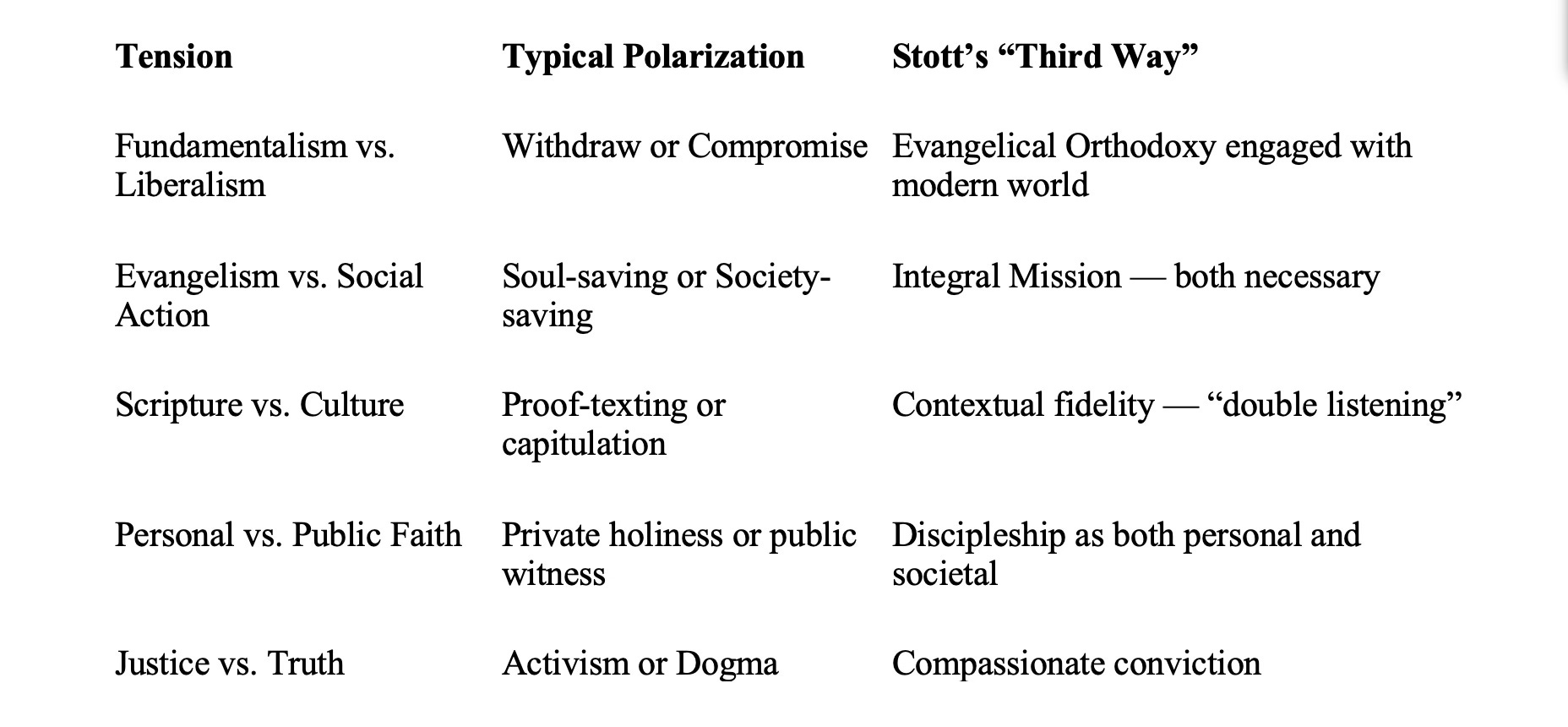
Back to Third Waylon-ism. Did he drop the bone seeing the superior, third option hanging in front of him? Well….no. It would certainly make for a better ending to the story and a better defense for Third Way-ism, wouldn’t it? Forgo the ditches Waylon, take the higher path! Like all of us, Waylon prefers the security of the overly simple; the comfortable predictability of solutions that do not challenge his assumptions. I ended up having to wrestle that bone out of his mouth and bloodied my hand on a sharp edge of his tooth in the process.
We discover God’s truth by seeking His whole counsel, not just part of it. This involves embracing instances of paradox which G.K. Chesterton defined wittingly as “a truth standing on its head, waving its legs to get our attention.” Several come to mind. Loving God’s truth propels us to love the people who habitually betray it. God is sovereign, yet we are responsible. Christ is fully God, while also being fully human. We are saved by grace, yet called to good works. We are called to hold conviction with heart while simultaneously heralding charity with humility. To be sure, “Third Way-ism” or “Winsome Christianity” is for some, a mask for “Mushy Middle-ism.” A kind of “I want to sit on the fence, without picking a side” hodgepodge that avoids conflict at the cost of clarity. There is no room for such complacency in the Christian faith, and little margin left for such an approach in our increasingly secularized world. We must choose to contend for the faith that was once for all delivered to the saints (Jude 1:3). But we must also acknowledge that we have a proclivity for pragmatic, binary thinking, that is rendered, at times, without considering the full panoply of biblical revelation. God does not always reveal Himself in packages neatly wrapped, which is why the gold of His wisdom is discovered only after much digging. But it’s there, the transcendent truth. Tensions and all. God is serving steak, so don’t settle for the bone.